What are Perler beads? Sizes and brands
3 min read
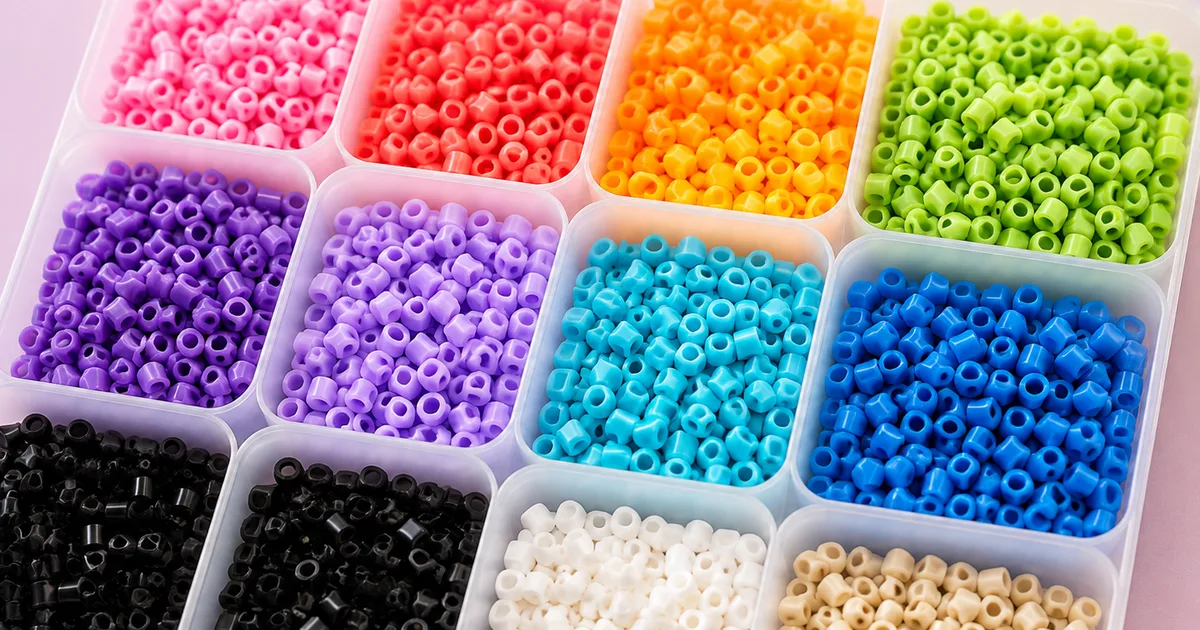
What Perler beads are, how midi, mini and maxi sizes differ, how Hama, Perler, Artkal, Nabbi and Pyssla compare, and what to buy for a first project.
Perler beads are small tubes of coloured plastic that you arrange on a pegboard and then fuse together with an iron. Melt the tops and the tubes weld into a single flat sheet: a keychain, a coaster, a piece of wall art. The craft has a different name almost everywhere it is sold — fuse beads, melty beads, Hama beads, Bügelperlen, perles à repasser — but the beads, the boards and the method are the same.
What the beads are made of
Each bead is a short cylinder of low-density polyethylene with a hole through the middle. That plastic starts to soften at about 105–115 °C, far below the temperature of a household iron on its cotton setting, which is why a few seconds of medium heat through a sheet of parchment paper is enough to fuse a whole board. The hole is not decorative: it lets heat reach the inside of the bead and it is what gives a finished piece its honeycomb look.
Sizes: mini, midi and maxi
Midi beads are 5 mm wide and 5 mm tall, and they are what "Perler beads" means unless somebody says otherwise. A standard square pegboard holds 29×29 of them, which is a piece roughly 14.5 cm on each side.
Mini beads are 2.5 mm from Hama and Nabbi, 2.6 mm from Perler and Artkal. They pack four times as much detail into the same space, which makes them the right choice for portraits and small game sprites, but you will want tweezers and good light. Maxi beads are 10 mm and exist for toddlers.
Sizes do not mix. A chart drawn at 29×29 midi beads is a different physical object in minis, so decide the size before you start counting beads.
Hama, Perler, Artkal, Nabbi and Pyssla
Perler is the American brand; Hama is Danish and dominant in Europe; Artkal is Chinese and sells the widest colour range, including soft, low-saturation shades that photographs love; Nabbi is the other Scandinavian option, and Pyssla is IKEA's own, cheap and perfectly usable. All five make 5 mm midi beads on compatible boards.
The real differences are the palettes. Perler names its colours ("Cheddar", "Toothpaste"), Hama numbers them (H21 is red), Artkal uses letter-number codes. A pattern is only ever as accurate as the palette it was drawn against, which is why the tools on this site let you pick your brand first — try the image-to-pattern converter or start from scratch in the pattern editor, and every colour will carry the codes your brand actually prints on the bag.
What to buy for a first project
A starter set of 3,000 to 5,000 beads in ten or fifteen colours, one square 29×29 pegboard, a sheet of parchment or the ironing paper that came in the box, and an iron. That is the whole list. Skip the bead pens and the storage towers until you know whether the craft sticks.
If you want something to make on the first evening, the free bead pattern gallery has charts with the bead count printed on them, so you can check you have enough of a colour before you start rather than three hundred beads in. When you are ready to turn your own photo into a chart, the Hama bead pattern maker does it in the browser.